CoQ10 for Blood Pressure: Does It Work Better If You’re on a Statin?
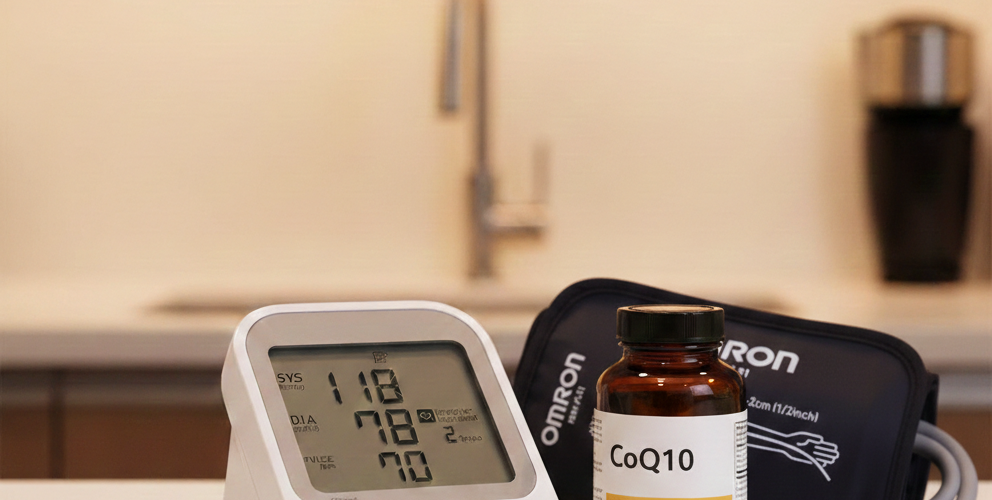
First, what exactly is CoQ10? Coenzyme Q10 — also called ubiquinone — is a compound your body makes naturally. It sits inside your cells’ mitochondria (the tiny power plants that produce energy) and helps generate ATP, the fuel that keeps everything running. Your body produces most of its CoQ10 internally, though you also get small amounts from foods like meat, fish, nuts, and oils. The organs that work hardest — your heart, kidneys, liver, and brain — have the highest concentrations.
If you’re taking a statin for cholesterol, you’ve probably heard the whispers: statins deplete CoQ10. Maybe you’ve even bought a bottle. But here’s what most people don’t realize — the connection between statins, CoQ10, and blood pressure is real, just not in the way you’d expect.
The most-cited verdict on CoQ10 and blood pressure is probably wrong — or at least incomplete. A 2016 Cochrane review — the type of rigorous analysis doctors consider definitive — looked at just 2 small trials with 50 total participants and concluded CoQ10 has ‘no clinically significant effect on blood pressure.’ Case closed, right?
Not quite. A 2022 analysis of 26 randomized controlled trials with 1,831 participants found something very different: CoQ10 reduced systolic blood pressure by nearly 5 points in people with cardiometabolic conditions — diabetes, high cholesterol, metabolic syndrome. That’s the population most statin users belong to. The connection isn’t that statins make CoQ10 work better for blood pressure. It’s that statins deplete CoQ10, and people taking statins are usually the same people with cardiometabolic conditions where CoQ10 actually helps.
Why Blood Pressure Matters
High blood pressure affects nearly half of American adults and is the leading modifiable risk factor for heart disease and stroke. What makes it dangerous is its silence — most people have no symptoms until serious damage has occurred. The numbers matter: every 10-point increase in systolic pressure raises stroke risk by 25% and heart attack risk by 15%. The flip side is equally powerful: modest reductions translate directly into fewer cardiovascular events.
Key Takeaways
- CoQ10 reduces systolic blood pressure by about 4-5 points (roughly 3-4%) — but only in people with cardiometabolic conditions like diabetes, high cholesterol, or metabolic syndrome
- The optimal dose is 100-200mg daily; higher doses don’t work better and may work worse
- Statins deplete CoQ10 by 16-54%, and most statin users have the cardiometabolic profile where CoQ10 helps blood pressure
- Excellent safety profile with minimal side effects — one of the safest supplements available
What the Clinical Trials Actually Found
The 2022 analysis in Advances in Nutrition pooled data from 26 randomized controlled trials involving 1,831 people with cardiometabolic disorders. CoQ10 supplementation reduced systolic blood pressure by 4.77 mmHg — roughly a 3-4% reduction for someone with readings around 140. The researchers found the effects were most pronounced in people with diabetes and dyslipidemia (abnormal cholesterol), and in studies lasting longer than 12 weeks.
A separate 2025 analysis focused specifically on people with type 2 diabetes found similar results: CoQ10 reduced systolic pressure by about 3.9 points and diastolic by 2.7 points across 16 trials.
But here’s where it gets interesting. The researchers discovered a U-shaped dose-response curve — meaning more isn’t better. The sweet spot was 100-200mg daily. Doses above or below this range showed less benefit.
Why did the Cochrane review reach such a different conclusion? Simple: it analyzed only 2 trials with 50 participants total, all with primary hypertension (high blood pressure without other metabolic conditions). The larger body of evidence shows CoQ10 works specifically in people with cardiometabolic diseases — not in otherwise healthy people who just happen to have elevated blood pressure.
The Statin Connection: It’s Real, Just Not How You Think
Statins reduce CoQ10 levels. This isn’t controversial — it’s basic biochemistry. Statins block an enzyme called HMG-CoA reductase to lower cholesterol. But that same enzyme is also needed to produce CoQ10. Block one, you reduce the other.
A 2015 analysis of placebo-controlled trials found statins reduce plasma CoQ10 by about 0.44 μmol/L — a significant drop. This effect was consistent across all statin types: atorvastatin, simvastatin, rosuvastatin, and pravastatin all showed similar reductions. A larger 2018 analysis of 12 trials with 1,776 participants confirmed the finding: statins reduce circulating CoQ10 regardless of whether they’re lipophilic or hydrophilic, high-intensity or moderate.
Individual studies have shown reductions ranging from 16% to 54% depending on the statin and dose.
So here’s the connection: statins deplete CoQ10. People on statins typically have diabetes, high cholesterol, or metabolic syndrome — the exact cardiometabolic profile where CoQ10 supplementation shows blood pressure benefits. The statin isn’t making CoQ10 work better; it’s creating a deficiency in a population that was already likely to benefit from supplementation.
How CoQ10 Works (The Simple Version)
Think of CoQ10 as a spark plug for your cells. It helps convert the food you eat into usable energy. Without enough of it, your cells — especially the hardest-working ones in your heart — can’t function at their best.
For blood pressure specifically, CoQ10 appears to work through several mechanisms:
Energy production: Your heart is essentially a pump that never stops — it beats about 100,000 times per day, every day, for your entire life. That requires enormous amounts of energy. CoQ10 sits inside the mitochondria (your cells’ power plants) and helps generate ATP, the fuel that keeps everything running. When CoQ10 levels drop, your heart muscle can’t produce energy as efficiently, which may impair its ability to pump blood effectively and maintain healthy pressure in your arteries.
Antioxidant protection: CoQ10 in its reduced form (ubiquinol) acts as a powerful antioxidant, neutralizing harmful molecules called free radicals before they can damage your cells. This matters for blood pressure because oxidative stress — an imbalance between free radicals and your body’s ability to neutralize them — contributes to blood vessel stiffness and dysfunction. Stiff arteries can’t expand and contract properly, which drives blood pressure up. By reducing oxidative damage, CoQ10 helps keep your blood vessels flexible and responsive.
Endothelial function: The endothelium is the thin layer of cells lining the inside of your blood vessels. Think of it as the “skin” of your arteries. Healthy endothelium produces nitric oxide, a molecule that signals blood vessels to relax and widen. When the endothelium is damaged or dysfunctional, vessels can’t dilate properly, and blood pressure rises. CoQ10 appears to support endothelial health, helping your blood vessels maintain their ability to relax when needed.
A Potential Bonus: Heart Failure Protection
Since CoQ10 supports heart muscle energy production, there’s a logical connection to heart failure — a condition where the heart can’t pump effectively. And unlike the blood pressure data, the heart failure evidence includes actual mortality outcomes.
The Q-SYMBIO trial — the largest and most rigorous CoQ10 heart failure study — randomized 420 patients with moderate to severe heart failure to either CoQ10 (100mg three times daily) or placebo for 2 years. The results were striking: major adverse cardiovascular events occurred in only 15% of the CoQ10 group versus 26% of the placebo group — roughly a 50% relative risk reduction. All-cause mortality was 10% versus 18%. Cardiovascular mortality was 9% versus 16%.
The American Heart Association’s 2023 scientific statement on complementary medicines in heart failure acknowledged these findings, noting that CoQ10 “was associated with a significant improvement of New York Heart Association functional class and reduction in major adverse cardiovascular events” — though they called for larger trials before making definitive recommendations.
A comprehensive 2021 review of CoQ10 for heart failure found “moderate-quality evidence that coenzyme Q10 probably reduces all-cause mortality and hospitalisation for heart failure.”
If you’re taking CoQ10 for blood pressure and have any degree of heart function concerns, this is a meaningful bonus.
Who Benefits Most
Based on the research, CoQ10 for blood pressure makes the most sense for:
- People with type 2 diabetes. Multiple analyses show enhanced blood pressure benefits in this population — roughly 4-5 point reductions in systolic pressure.
- People with dyslipidemia (abnormal cholesterol). The 2022 analysis found this subgroup showed more pronounced effects.
- People taking statins. Not because statins make CoQ10 work better, but because statin users are typically in the cardiometabolic population where benefits appear, AND they’re depleted of CoQ10 by the medication itself.
- People with metabolic syndrome. The cluster of conditions — elevated blood sugar, abnormal cholesterol, abdominal obesity, high blood pressure — defines the population where CoQ10 shows consistent benefits.
Who probably won’t benefit:
- People with primary hypertension only. If your blood pressure is elevated but you don’t have diabetes, cholesterol issues, or metabolic syndrome, the evidence for CoQ10 is weak. The Cochrane review’s skepticism applies here.
- People with normal blood pressure. CoQ10 doesn’t appear to lower already-normal readings.
What If You’re on a Statin But Your Blood Pressure Is Normal?
This is a common question. Statins definitely deplete CoQ10 — that’s well-established. But should you supplement if your blood pressure is already healthy?
The honest answer: the blood pressure evidence doesn’t apply to you. The trials showing CoQ10 lowers blood pressure were conducted in people with elevated readings. There’s no evidence CoQ10 will lower already-normal blood pressure, and that’s actually a good thing — you don’t want a supplement that drops your BP when it doesn’t need dropping.
However, CoQ10 does more than affect blood pressure. Some people take it for general cellular energy support, potential heart failure prevention, or to address the depletion caused by statins. The Q-SYMBIO trial showing reduced mortality in heart failure patients wasn’t about blood pressure — it was about heart muscle function.
If your blood pressure is normal but you’re on a statin and want to replenish what the medication depletes, that’s a reasonable choice — just don’t expect blood pressure changes. You’d be supplementing for different reasons: cellular energy, antioxidant protection, and potentially supporting heart muscle function over the long term.
How Much and What Kind
The clinical trials point to a clear optimal range: 100-200mg daily. The 2022 dose-response analysis found this range produced the greatest blood pressure reductions. Interestingly, higher doses didn’t work better — the relationship was U-shaped, meaning very high doses may actually be less effective.
The Q-SYMBIO heart failure trial used 100mg three times daily (300mg total), which also falls within effective ranges for cardiovascular benefits.
Ubiquinone vs. Ubiquinol: CoQ10 comes in two forms — ubiquinone (oxidized) and ubiquinol (reduced). Some research suggests ubiquinol has better bioavailability, but the evidence is mixed. One study found ubiquinol was more efficiently incorporated into cells. However, well-formulated ubiquinone products have also performed well in clinical trials, and the JACC review notes that both forms have been used successfully. The formulation and delivery system may matter as much as the form itself.
If you’re on a statin, your body is producing less CoQ10 than it normally would — that’s a side effect of how statins work. Starting from a lower level means you may need to supplement enough to actually get back into the range where benefits appear.
The practical takeaway: either form can work. If you’re over 40 or have absorption concerns, ubiquinol may have a slight edge. But don’t overpay for ubiquinol if ubiquinone fits your budget — the dose matters more than the form.
Timing: CoQ10 is fat-soluble, so take it with a meal containing some fat for better absorption.
Side Effects
CoQ10 has one of the best safety profiles of any supplement. A comprehensive safety assessment found the observed safe level is 1,200mg per day — far above typical supplementation doses. The acceptable daily intake calculated from animal studies is 720mg for a 60kg person.
Adverse effects are infrequent and generally mild:
- Mild GI symptoms (nausea, diarrhea, decreased appetite)
- Occasional dizziness
- Rare reports of insomnia
The Journal of the American College of Cardiology notes: “In humans and animals, the safety of even high doses of supplemental CoQ10 over long periods is well documented. Adverse reactions in humans are infrequent and generally mild.”
Drug interactions: There are no known significant drug interactions. However, CoQ10 may improve blood sugar control in diabetics (potentially requiring adjustment of diabetes medications) and may have additive blood pressure effects with antihypertensive drugs. An older concern about CoQ10 reducing warfarin effectiveness was not confirmed in a randomized controlled trial.
Who should be cautious: If you’re on blood thinners, diabetes medications, or blood pressure medications, let your doctor know you’re taking CoQ10 so they can monitor for additive effects.
The Honest Limitations
Population-specific benefits. The blood pressure effects appear limited to people with cardiometabolic conditions. If you have isolated hypertension without diabetes or cholesterol issues, the evidence doesn’t support CoQ10 for blood pressure.
No cardiovascular outcomes data for blood pressure. We have strong evidence CoQ10 lowers blood pressure numbers in the right population. We don’t have large trials proving this translates to fewer heart attacks or strokes specifically from the blood pressure effect. (The Q-SYMBIO mortality data is for heart failure, a different indication.)
Cochrane skepticism persists. The 2016 Cochrane review remains widely cited despite its small sample size. Some clinicians still consider the evidence insufficient.
Quality variation. CoQ10 supplements vary in quality and bioavailability. Third-party tested products from reputable manufacturers are worth the modest premium.
ZenobiaPeak Score: CoQ10 for High Blood Pressure
If your blood pressure is normal, CoQ10 is not scored because there is little to no benefit for blood pressure.
| Score | Your Situation | BP Reduction | Optimal Dose | Notes |
|---|---|---|---|---|
| 60/100 | High BP + diabetes, high cholesterol, or metabolic syndrome | ~4–5 points systolic | 100–200mg daily | U-shaped dose response — more isn’t better |
| No Evidence* | High BP only, no other metabolic conditions | None demonstrated | — | Review found no benefit for only high blood pressure. |
We don’t assign scores to interventions without demonstrated effect. If you have primary hypertension only, the evidence doesn’t support CoQ10 for blood pressure — and we won’t pretend otherwise with a low number.
Product Recommendations
Research protocols for cardiovascular support and statin-related CoQ10 depletion typically used 100–300mg daily, taken with a fat-containing meal for optimal absorption. Allow 8–12 weeks before assessing full effects on blood pressure and energy levels.
Already Taking Magnesium?
If you’re following the magnesium protocol from our article “Magnesium for Blood Pressure: What Dozens of Clinical Trials Actually Show,” CoQ10 works through different mechanisms. Magnesium supports blood vessel relaxation directly; CoQ10 supports cellular energy production and antioxidant function. For someone with diabetes or metabolic syndrome on a statin, taking both CoQ10 and magnesium may provide more benefits than either one alone.
The Bottom Line
CoQ10 at 100-200mg daily reduces systolic blood pressure by about 4-5 points — but only in people with cardiometabolic conditions like diabetes, dyslipidemia, or metabolic syndrome. If you’re taking a statin, you’re likely in this population AND depleted of CoQ10 by the medication. The connection is real, just more nuanced than “statins make CoQ10 work better.”
For someone with type 2 diabetes and blood pressure of 142/88, adding CoQ10 could provide a meaningful 3-4% reduction with essentially no side effects. It’s not a replacement for medication, but it’s a legitimate, evidence-backed addition — especially if you’re already on a statin.
If you have isolated high blood pressure without metabolic issues, the evidence doesn’t support CoQ10 for this purpose. Save your money for interventions with stronger evidence in your specific situation.