How a B-vitamin almost ruined my health
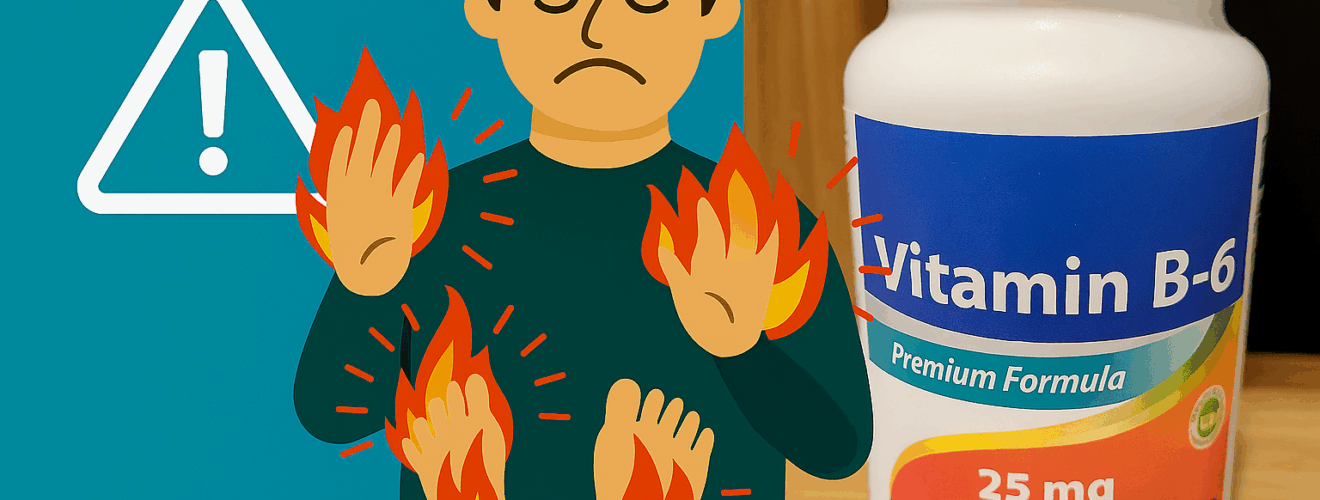
A few years ago, I began experimenting with different supplements and vitamins, hoping to improve my overall health and longevity. Unfortunately, I ended up creating a mini health crisis for myself that was both surprising and alarming. This experience inspired me to start ZenobiaPeak—not only to uncover leading research that can help you make informed decisions about your health, but also to explain potential risks and side effects that often go overlooked.
Like many people, I assumed (incorrectly) that over-the-counter products must be safe, or they wouldn’t be allowed on the market. I can’t recall every detail of what I was taking during my health scare, but it was a mix of multivitamins, a few other supplements, and vitamin B6 (25mg tablets) that I bought on Amazon. I don’t remember my exact reason for taking B6, but it was based on the uneducated assumption that vitamins are harmlessly flushed out of your system.
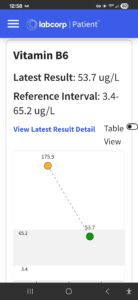 So, what did I experience? I had persistent, painful tingling and numbness in my fingers and toes. At first, I thought it might be related to my hypothyroidism or just aging. During a routine visit, I told my doctor about these symptoms, and she ordered a full panel of blood work. To our surprise, my blood level of B6 was 2.7 times the maximum reference interval. I immediately stopped taking all supplements and vitamins and started researching whether my other products could have harmful side effects.
My doctor diagnosed me with vitamin B6-induced peripheral neuropathy. Research shows that this kind of nerve damage can happen even at doses commonly found in supplements or energy drinks, especially if taken for a long time. I had been taking B6 almost daily for about six months.
Thankfully, after about a month, the symptoms mostly went away and my blood levels dropped, but I still wonder if there could be long-term effects.
Vitamin B6 is essential for over 150 biochemical reactions in the body, including amino acid, carbohydrate, and lipid metabolism, neurotransmitter synthesis, and antioxidant functions. Deficiency can lead to neurological symptoms, anemia, and increased risk of chronic diseases. However, taking more than the recommended amount does not provide extra benefits and can actually be harmful.
The U.S. FDA sets the Daily Value (DV) for labeling at 1.7 mg for adults and children ages 4 and up. The maximum Upper Limit (UL) is set at 100 mg/day for adults, which is much higher than the European Food Safety Authority (EFSA) limit of 12 mg per day, and even higher than the German Federal Institute for Risk Assessment (BfR) limit of 0.9 mg/day.
Physicians may recommend vitamin B6 doses as high as 100 mg only in specific clinical scenarios, most commonly for rare genetic disorders or to counteract drug-induced deficiency, but such dosing carries significant risk and requires close monitoring.
Large doses of vitamin B6 are still allowed to be sold due to historical regulatory standards and the perception that water-soluble vitamins are generally safe. However, recent evidence has prompted the EU and BfR to lower the tolerable upper intake level (UL). Despite these changes, supplements with higher doses remain available, which has led to cases of toxicity.
I checked my Amazon account to see if the B6 I purchased was still for sale. It is—and it has 6,392 reviews with an average of 4.6 stars. Shockingly, I could only find one review warning about the safety profile: “B6 is toxic to your nerves. Vitamin B6 can be toxic and can cause lifelong health problems. The recommended daily allowance is less than 2mg. Please do your research.” Well said!
Clearly, the U.S. upper limit needs to be re-evaluated. The bottle of B6 I purchased says, “take one (1) tablet one to three times daily.” While 75mg is below the U.S. upper limit, you have to consider what else you’re consuming: multivitamins, supplements, food, energy drinks, etc. Even though I only took one 25mg tablet per day, it accumulated in my body faster than it could be expelled, causing what sometimes felt like fiery pain.
While I support supplementation and doing everything we can to lead a healthy life, we must research the safety and efficacy of these products, check in with our physicians, and get bloodwork to monitor for problems.
Vitamin B6 is vital for health, but my personal recommendation is to exercise caution given the high risk of nerve damage. The limited benefit from supplementation beyond the U.S. recommended daily value of 1.7 mg for adults and children ages 4 and up is not worth the risk unless you have a proven deficiency.
References
-
- The Role of Vitamin B6 in Peripheral Neuropathy: A Systematic Review. Muhamad R, Akrivaki A, Papagiannopoulou G, Zavridis P, Zis P. Nutrients. 2023;15(13):2823. doi:10.3390/nu15132823.
-
- Vitamin B in Health Supplements and Neuropathy: Case Series Assessment of Spontaneously Reported Cases. van Hunsel F, van de Koppel S, van Puijenbroek E, Kant A. Drug Safety. 2018;41(9):859-869. doi:10.1007/s40264-018-0664-0.
-
- The Effect of Vitamin B6 on Cognition. Malouf R, Grimley Evans J. The Cochrane Database of Systematic Reviews. 2003;(4):CD004393. doi:10.1002/14651858.CD004393.
-
- Vitamin B6 in Health and Disease. Stach K, Stach W, Augoff K. Nutrients. 2021;13(9):3229. doi:10.3390/nu13093229.
-
- Vitamin B6 and Diabetes: Relationship and Molecular Mechanisms. Mascolo E, Vernì F. International Journal of Molecular Sciences. 2020;21(10):E3669. doi:10.3390/ijms21103669.